
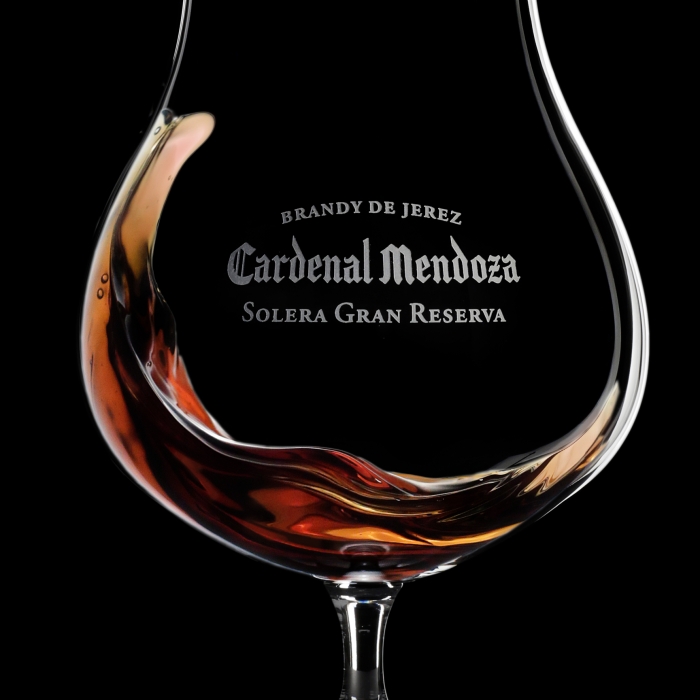
The art of distillation arrived in Europe when the Arabs conquered Spain in 711 BC. At first, it was used by alchemists to produce perfumes or medicines, but later they discovered that it could be used to protect wines during shipping. Suddenly, they observed that the spirit aged well in barrels and began producing small quantities of what we now call brandy. However, what we know today as Brandy de Jerez dates back to the late 19th century, when sales of this product began to see considerable success.
The word "brandy" derives from the Dutch "brandwijn" or "burnt wine."
Any region that produces wine will also have its own brandy. Most are very good, but there are only three in the world that have a protected designation of origin: Cognac, Armagnac, and Brandy de Jerez. All three are excellent but very different from one another.
 Cognac is a city located in the Charentes region (in western France), where distillation began in the early 17th century. For many years, the Dutch purchased local wine both for consumption and for distillation to make gin or liqueurs. They soon realized that distilled wine was cheaper to transport, and Cognac became the center of brandy production. The wine is primarily made from Ugni Blanc grapes and is distilled twice in stills still known as "Charentais alembics." Cognac is aged statically in 350-liter French oak barrels and blended with younger spirits. Cognac received its Appellation d’Origine Contrôlée (AOC, Controlled Designation of Origin) in 1936.
Armagnac comes from the Gascony region in southwestern France and has been produced since the 14th century. Located inland, this fine brandy has never quite managed to reach the heights of its coastal rival, Cognac, but it is a very worthy competitor. The main grape varieties are Ugni Blanc and Baco 22A. The wine is distilled only once, in a simple column still. The spirit obtained is aged in French oak barrels and blended with younger spirits. Armagnac also received its Appellation d’Origine Contrôlée (AOC) in 1936.
Brandy from Jerez has been around since the 16th century and almost certainly long before that. It also became popular with the Dutch, which is why the finest spirits are called "holandas." Unlike French brandies, this one is distilled from wines made from the Airén grape variety, using either pot stills or column stills, depending on the quality required. It is then aged using the traditional criaderas and soleras system, also used in the production of sherry.

The barrels used, known as "botas," are made of American oak and have a capacity of 600 liters. These barrels previously stored the famous sherry, so the aromas linger in them and, consequently, in the Brandy de Jerez. This offers us a wonderful variety of styles and aromas in the final brandy.
Although Brandy de Jerez is probably the oldest brandy, it received its Denomination of Origin (DO = AOC) in 1989.


