
The case of Rodolfo Romero is surprising, but unfortunately, it is not unprecedented. Year after year, we see new counterfeiters emerge who seek to replace genuine bottles with fakes using highly sophisticated techniques that make it very difficult to determine which bottle is real and which is not.
Proof of this is the famous large-scale counterfeiting scheme carried out by Rudy Kurniawan. Rudy—as the mastermind behind the counterfeit bottle of Napoleon’s brandy also called himself, perhaps in an attempt to pay homage to the historical figure—had very clear objectives. He wanted to sell bottles of very famous vintages of French wine that he had counterfeited himself, and then use the money raised to buy the originals.
Quite a business, isn’t it?
However, something went wrong with the plan.
His greed led him to create bottles of vintages that had never been produced—selling wines produced years before the winery was founded—or to sell more bottles than were produced that year.
Of course, this caught the attention of the authorities, who decided to search his home. The police were taken by surprise when they discovered bottles, corks, and fake labels in his “laboratory”—which was, after all, just his kitchen!
At the end of his criminal career, Rudy Kurniawan made 2.5 million euros from counterfeit Burgundy wines, though he was ultimately sentenced to 10 years in prison, ordered to pay 28 million euros in compensation to the victims, and had his private collection of 5,000 bottles of wine auctioned off. This time, however, they were genuine.
The booming business in China
We all know that China produces everything on a large scale, and, as one might expect, wine is no exception.
As early as 2013, more than 40,000 bottles of counterfeit wine with a market value of 36 million euros were seized. According to the latest estimates, it is believed that 40% of the wine sold in China is counterfeit.
But how do you replace the contents of a bottle that is worth thousands of euros at auction? Well, two techniques are primarily used.
The first method relies on the use of bulk wine. Thirty-six percent of the bulk wine sold in China comes from Spain, so it is reasonable to assume that a large portion of the counterfeit bottles produced using this technique contain wine from our country.
The second most common technique is to fill the bottle with vintages of the same wine, but from less exceptional years, and therefore less expensive. This technique makes it nearly impossible to distinguish a genuine wine from a counterfeit one unless you are an expert in the field.
In fact, the counterfeiting industry has reached such a point that Chinese authorities have developed a sophisticated method for detecting tampered bottles without having to open them.
The use of a ray of light.
The technique involves shining a beam of light through the bottle, which, based on a series of specific data and metrics, displays a result that confirms its authenticity—or not.
It is important to remember that bottles of famous vintages are typically used as a physical investment vehicle. They are purchased and stored for future resale when their value appreciates, so the bottles are rarely opened.
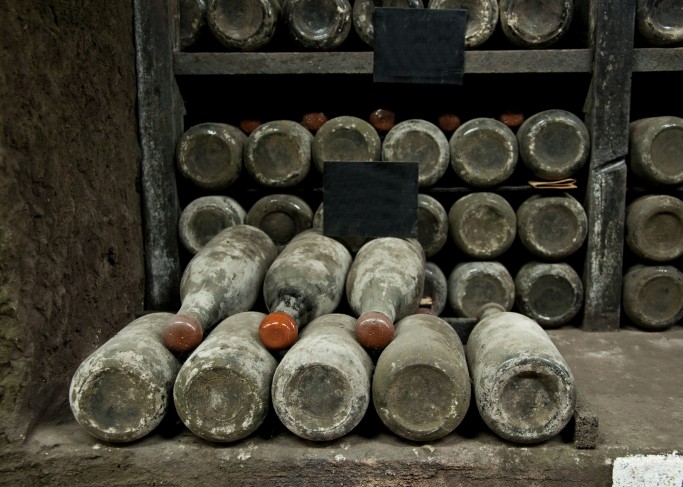
As you can see, the world of counterfeits is an industry that is present in the collecting sector at all levels. However, the case of wine is particularly difficult to detect due to the high level of complexity involved in determining whether a wine is authentic—or not—without verifying its contents.
To this end, the famous auction house Christie’s sends its wine department to wineries and/or private collectors who are putting some of their treasures up for sale to verify that the wine is in good enough condition to be auctioned, as well as its provenance.
After all, your reputation is also at stake.
There is still some doubt as to whether our protagonist, Rodolfo Romero, was responsible for the case of the counterfeit bottle of Cardenal Mendoza brandy that belonged to Napoleon; however, as you can see, this is not the only—nor surely the last—case of counterfeiting that has occurred in the industry.
Was Rudy guilty or innocent? That is the question everyone is trying to answer.
If you want to learn more about ‘Rudy,’ we recommend reading this post where we reveal the keys to his journey and personality. A complete mystery that remains relevant and unsolved.


