
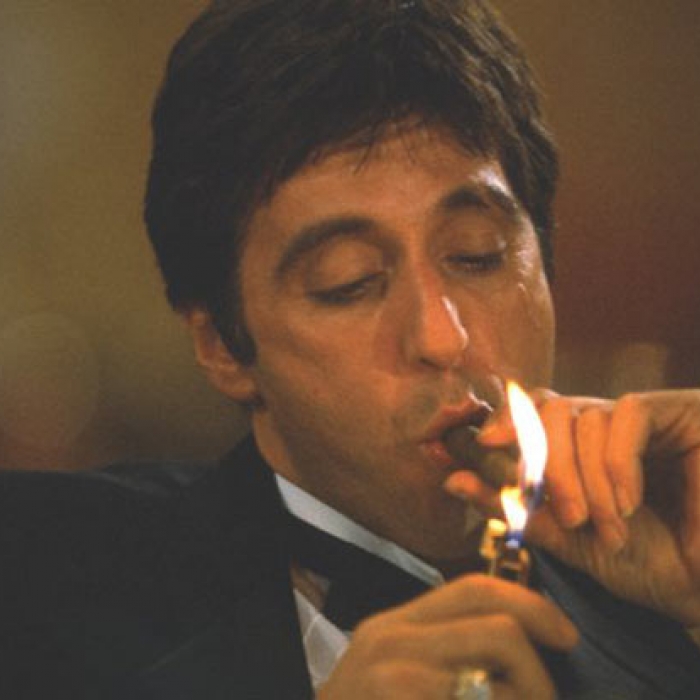
Unlike cigars, which are mass-produced by machines, Cuban cigars are made one by one by hand, and like a glass of Cardenal MendozaThere are many reasons that justify its complexity and personality
The Anatomy of a Cigar
Cuban cigars are made only with tobacco leaves, and the type, age, and size of these leaves give each cigar its distinctive appearance and flavor. Cigars are composed of three different parts:

Stuffed
Making up the bulk of the cigar’s body, these leaves help air flow through it. The filler, or filler, is a mixture of three different types of tobacco leaf, depending on which part of the tobacco plant they come from.
Light, upper leaves. 
These leaves burn slowly and are located in the middle of the cigar. Although they are called “light leaves” because they receive the most sunlight, they also have the strongest flavor.
The leaves are aged for a minimum of two years before being used.
Dry, the middle leaves.
Of medium strength, these leaves are lighter in color and used for their aroma. They are aged for 12 to 18 months before use.
The lower leaves flew out.
Due to less exposure to light, these leaves have a mild flavor but burn more efficiently. They are included to ensure the cigar doesn’t go out. They are aged for at least 9 months before use.
Cloak
The binder holds the filler and gives the cigar its shape. They are aged for at least 9 months before being used.
Layer
The wrapper leaves come from plants grown in shaded fields, meaning they are completely covered with muslin to ensure darker, longer leaves. These unique leaves are used to wrap and finish the cigar. They are aged for a minimum of six months before use.
Size
Size has nothing to do with the strength or flavor of a cigar, as these qualities come from the leaves used in its construction. Since cigars are priced by weight, size does affect the final price: the smaller the cigar, the cheaper it will be. Cigars of similar size will have the same price regardless of the producer.
The endless variety of cigar sizes can be confusing. There’s the cylinder size, then the length, and finally the… format name.

The cylinder size refers to the thickness of the cigar. It is based on one inch divided into 64 parts. For example, a size 32 cigar will be half an inch thick, while a size 48 cigar will be three-quarters of an inch thick, and so on. The cylinder size combined with the length is called a “vitola,” a standard for measuring cigar size. These vitolas have become synonymous with cigar size.
There are many sizes of cigars, but the most popular are the following:
Petit Corona (5 1/8” x 42 cylinder base or 129 mm x 16.5 mm diameter) 30 min to smoke it.
Crown (5 5/8” x 42 or 142 mm x 16.5 cylinder base) more than 30 min to smoke it.
Robust (4 7/8” x 50 or 24 mm x 20 mm in diameter) more than 45 min to smoke it.
Churchill (7” x 47 or 178 mm x 18.5mm diameter) 60 min to smoke it.
Double Corona (7 5/8” x 49 or 194 mm x 19.45 mm in diameter) more than 75 min to smoke it.
Rules for smokers
The end of the cigar must be completely removed by a cigar guillotine.
Cigars should always be lit with a wooden match; never use a candle or a gasoline lighter because they will cloud their flavor.
Take your time to light the cigar, hold the flame at 90º until it is well lit.
Unlike conventional cigarettes, with cigars you don’t inhale the smoke. You hold the smoke in your mouth first and then exhale it. Your taste buds will perfectly capture the flavor of the cigar.
Like brandy, a cigar should be enjoyed calmly; taking strong puffs can cause it to burn too much and thus make the flavor disappear.
You don’t have to throw away the ash, it will fall on its own when necessary.
The longer the cigar, the slower it will burn. Remember that size doesn’t necessarily mean it has more strength or flavor.
Remember, your cigar has passed through many experienced hands in its production process: from the farmer who planted the tobacco, to the one who hand-picked it, sorted it, aged it, and produced it.
Take your time to enjoy it!


